HomeLoreStatusFAQSupport on Patreon
The Codex of Breedhaven

Lore

What the Expanse knows about itself — studied, taught, and argued over in every seminar room at the University.

The first cause

The Primordial Bloom
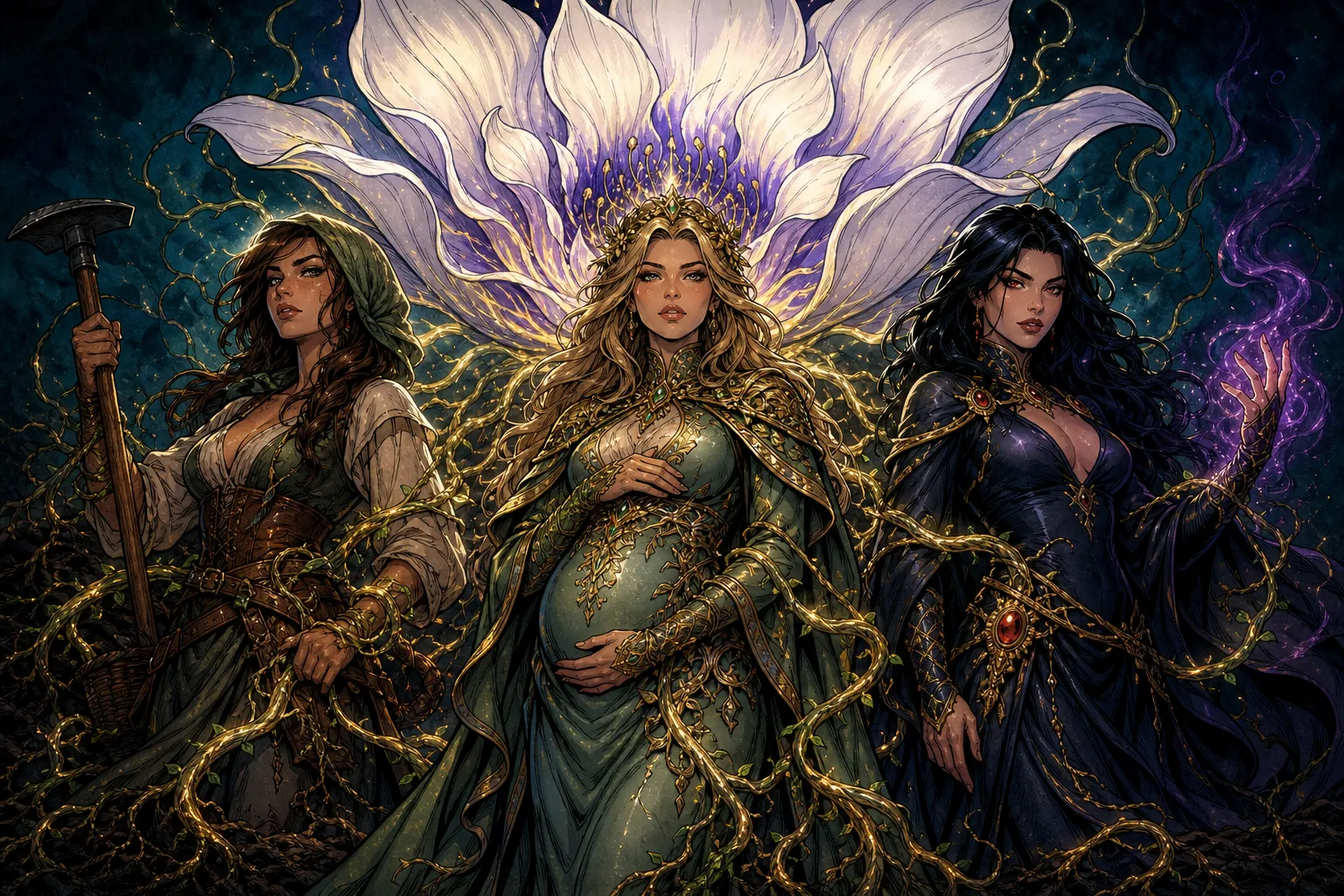
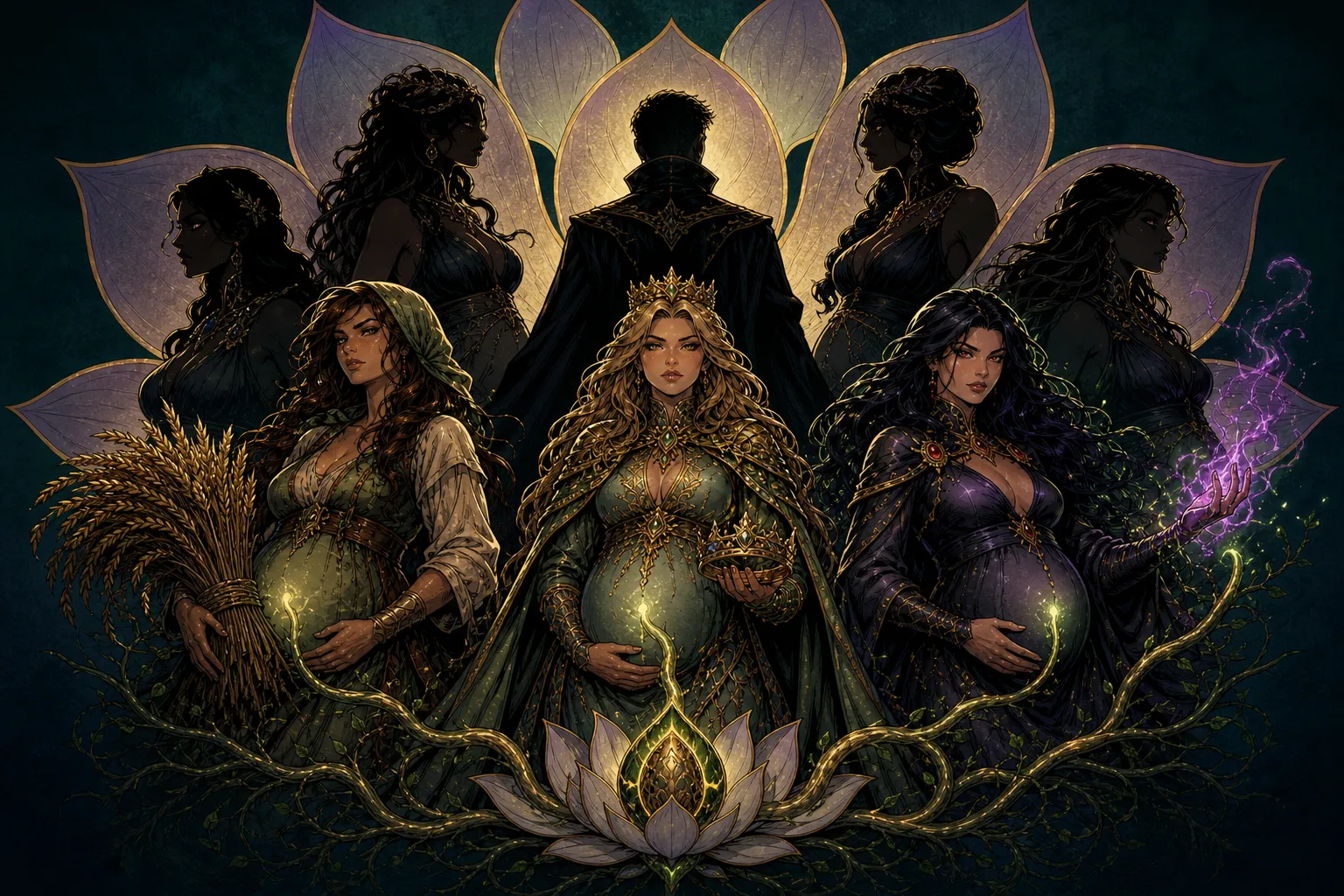
Three women of field, crown, and magic bound by golden roots to the immense Primordial Bloom

The Primordial Bloom is the living magic of the world: an active force in soil, water and blood, not a distant god. Its rules are known and studied. Seven girls are born for every boy. Only women can work magic. Only about one man in ten is fertile. Pregnancy greatly amplifies a woman's magic.

In women the Bloom is felt as a drive to create, nurture, grow and protect life. Pregnancy is its strongest expression and its strongest pull. A woman near a fertile man feels it as warmth, attention and want — strongest in the young and in those who have never carried a child, and gone after menopause. It is an instinct, not a command: she chooses what to do about it. Bloom suppressants, called dampers, are cheap, legal and ordinary, and turn the pull down to a background hum.

Whether the Bloom's wants are a woman's own is the oldest argument there is. Bloomists hold that they are sacred, and that fighting them is fighting nature. Freewill advocates answer that the Bloom may lean on a woman but does not own her. Every child learns the saying: “The Bloom gave women magic and men the seed. Civilization gave us everything else.”
— i —
One man in ten

True Sires

Women outnumber men seven to one across the Sown Expanse, and most men cannot father children. Roughly one in ten can. They are True Sires, and civilization has organised itself around how few of them there are.

A True Sire is not powerful; he is valuable. The law protects him heavily, and paternity, inheritance and reproductive contracts have whole courts of their own. Fertility is established by a clinical assay and recorded in the national Sire Registry. The record is private by law and a Sire's status is his to disclose — asking on a first date is very rude. In practice it leaks, and a known Sire lives with constant attention, some of it flattering and much of it wearying: he is treated as a prospect before he is treated as a person.

Men who are not fertile have the opposite trouble. They are a small minority in every room and of no interest to the Bloom, and many feel invisible.

A True Sire of record assay is international news. Until this year the highest ever measured belonged to Joven Stormbreaker of the Starkelands. Then a first-year from outside the Expanse sat his assay at Breedhaven University, and the result did not stay private.

— ii —
The surge

Pregnancy and Magic

One man encircled by seven women, with pregnancy linked to harvest, royalty, and magical power

Pregnancy is a magical state as much as a bodily one. From the first weeks a woman's power rises, and it keeps rising: a small lift early on, a marked one by the middle months, and exceptional strength near term. A middling student at six months can out-cast her professor. Carrying a True Sire's child is no different in kind, only stronger.

The surge is useful and dangerous. Workplaces and laboratories have rules for it, the most demanding circle-work in industry and medicine is led by pregnant mages, and sport keeps a separate Bloom division. Birth ends it with a discharge of magic strong enough to crack masonry, so hospitals deliver in warded Bloom Chambers. The Bloom hurries all of it: a pregnancy is counted in weeks, and under two months from conception to birth is ordinary.

Because the Bloom pushes hard and Sires are few, reproductive medicine is the largest and best-funded science there is. Contraception is safe, cheap and free at any clinic, and it is the default. Conceiving is a decision — one a woman makes knowingly, and one both people know has been made. When it takes, she feels it at once, as certainty and a rush of magic.

— iii —
Wards and wifi

Magic and Technology

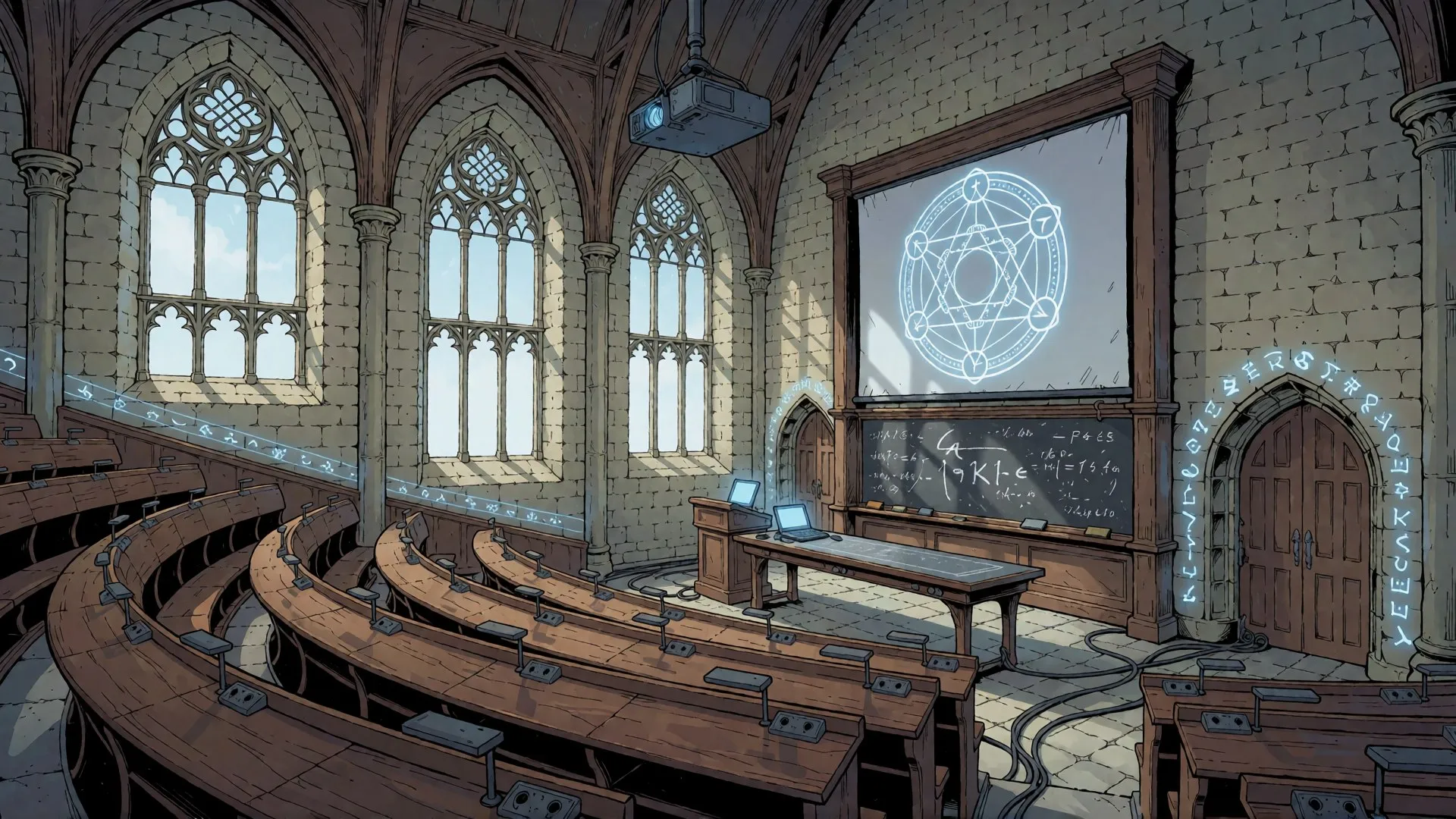
A gothic lecture hall with a projector showing a magic circle and warding runes glowing along the walls

Magic never replaced technology, because the two solve different problems. A mage can heat a room; a power station heats a city. A healer can close a wound; a hospital treats thousands. Magic is personal, limited and tiring. Technology is scalable and predictable. So the world has both, built into each other.

Ordinary life has phones, the net, trams, trains, lifts and medical imaging. It also has wards on doors and windows, self-mending stone, growth-charmed crops, healing magic in every clinic, and short-range teleport arrays at the major stations. Engineers and mages work in the same firms, and “magical engineering” is simply engineering.

Most women's magic is modest: warming, mending, coaxing plants, easing pain, a light, a ward, a nudge. Stronger workings take training, a circle of several women, or pregnancy. Men have none at all.

Clothes never made the break with the past that machines did. Laced bodices, corsets, long gowns and working aprons are everyday wear, cut in modern fabrics and worn with a phone in the pocket, alongside jeans, hoodies and trainers. Nobody finds a gown in a lecture hall worth a remark.

— iv —
The kingdom

Breedhaven and Seedblossom

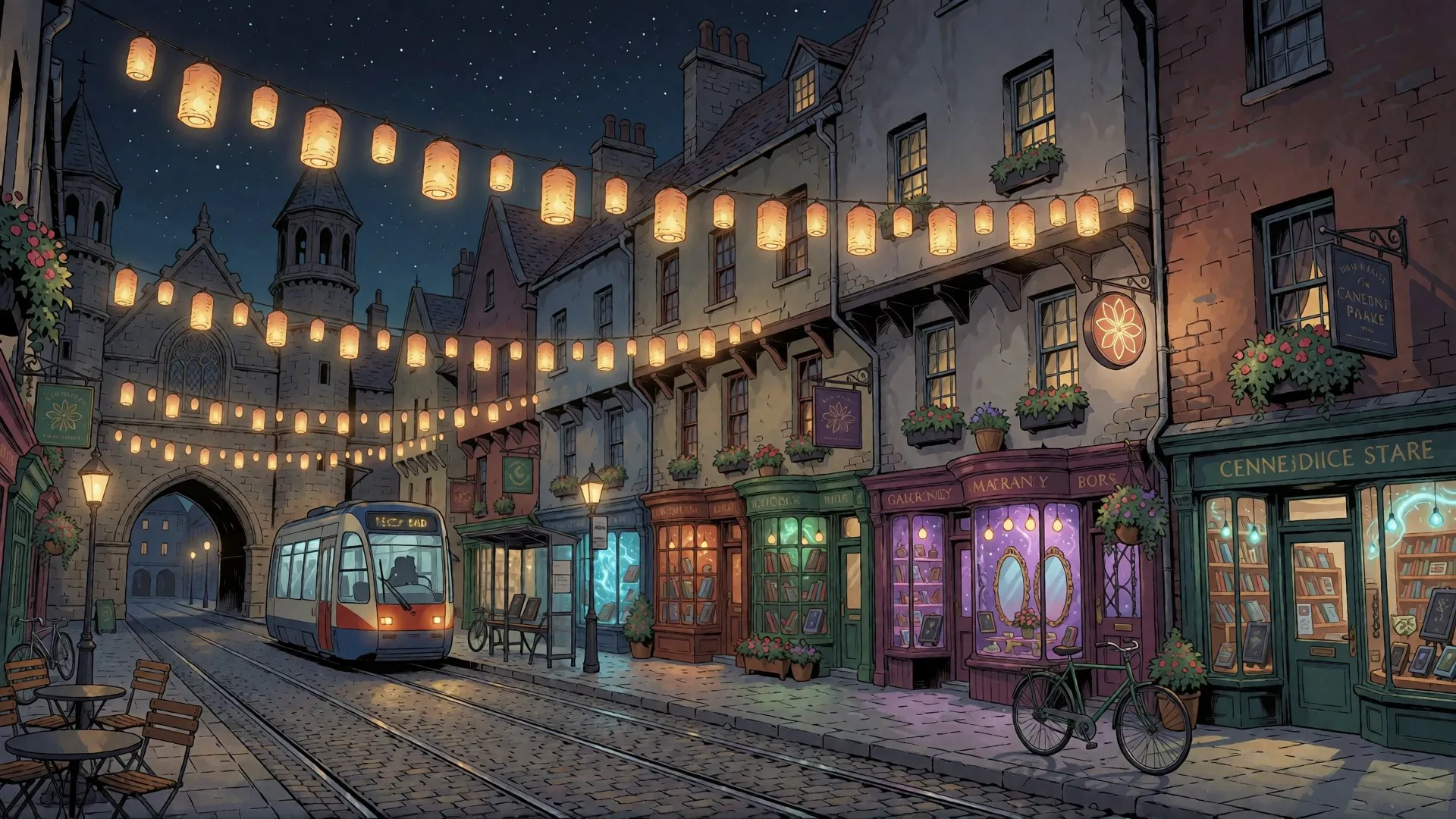
Lantern Row at night: a cobbled high street strung with paper lanterns, a tram passing lit shopfronts

Breedhaven is a green lowland kingdom of rivers and orchards, and one of the richest states of the Sown Expanse. It is a modern country — people ride trams, work in offices and laboratories, and argue about politics online — and a country of magic, and the two have grown up together for so long that nobody thinks of them as separate.

It is a constitutional monarchy under House Dawnbloom, with an elected Assembly. The previous queen, Seraphine IV, died suddenly. Her only heir, Seraphine V, is eighteen, newly crowned, and by long custom studying at the University.

Seedblossom is the capital: an old river city of stone bridges and orchard parks with a modern city grown through it, tram lines under plane trees and glass towers behind the cathedral quarter. The Assembly sits here, the crown keeps Dawnbloom House here, and the University fills the north bank.

Students know the streets outside the south gate best. Lantern Row is the high street: flats, shops, bars and late food. The Honeyed Bee is the student pub, Spell & Sip is the coffee shop everyone revises in, Cauldron is where you take someone you want to impress, Pixel and Rune is the arcade, and the Undergrowth is where people go dancing.

— v —
Seven centuries, thirty thousand students

Breedhaven University

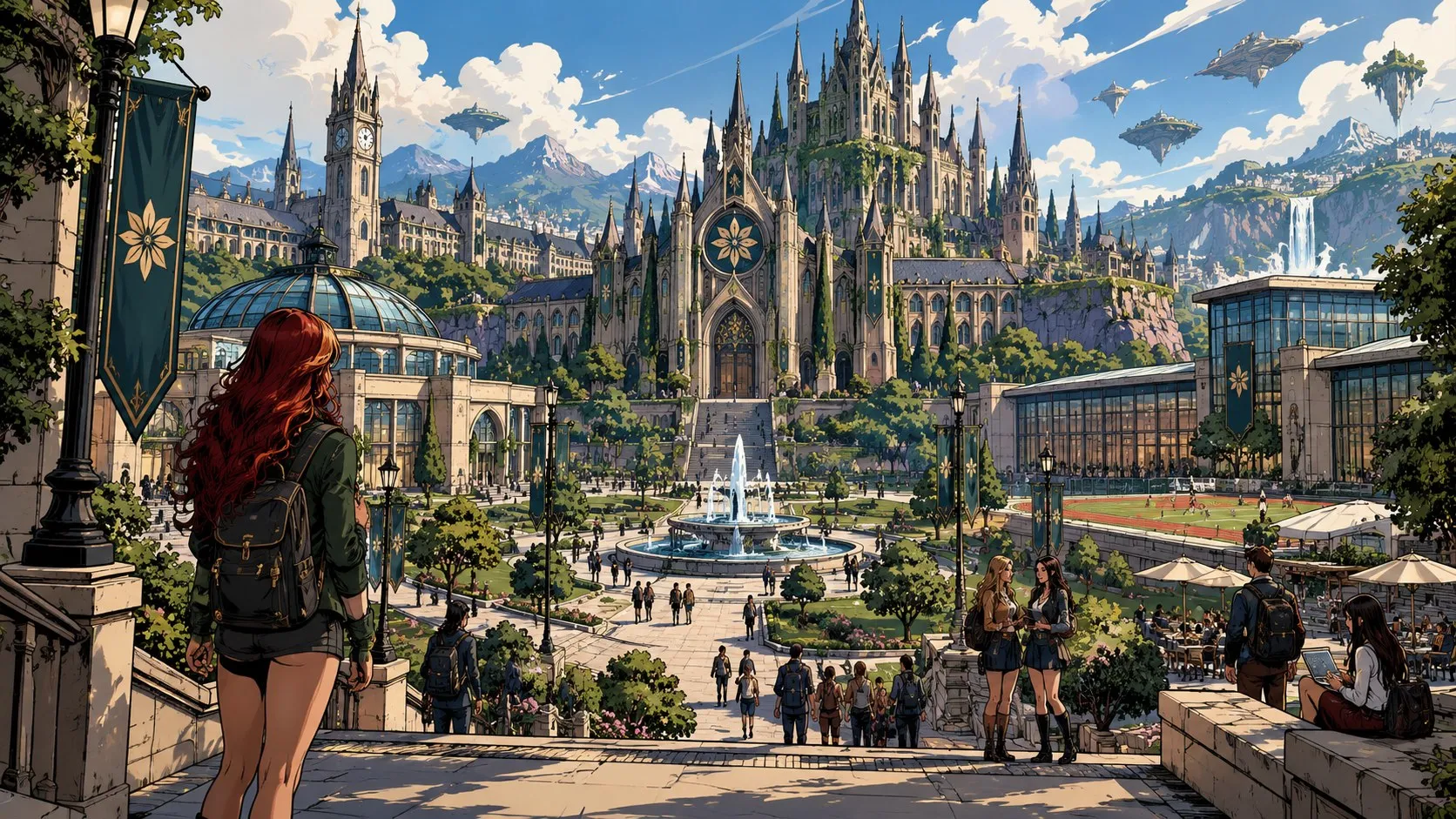
Students cross a fountain plaza below the spired gothic halls of Breedhaven University

Breedhaven University stands on a campus whose oldest stone is seven centuries old and whose newest building is the Foundry, a magical engineering lab. It is a modern university of some thirty thousand students: lectures, labs, residence halls, a dining commons, clubs, a student government and too little parking. Every student is an adult. About one in eight is a man.

Most subjects would be familiar anywhere. Others exist because of the Bloom: Bloomology, the science of the Bloom itself; Magical Engineering; Sire Genetics, the study of why so few men are fertile; Prenatal Thaumaturgy, which studies what pregnancy does to magic. Every first-year writes the Magical Ethics essay: does a will the Bloom leans on still count as free?

The Bloom shapes its institutions. The Reproductive Health Centre provides contraception, suppressants and prenatal care. Bloom Counselling is free. Pregnant students are moved up into advanced practicals for as long as the surge lasts, and work at a warded bench with a spotter; professors are used to it and congratulate them first.

Registered True Sires are offered rooms in a Sire wing with its own entrance, a security desk and a logged door. It is the best housing on campus and the most argued about. One side asks why Sires get luxury rooms. The other answers that somebody tries to walk off with one most years. Both are right.

— vi —
How people live

Households and Dating

With so few fertile men, the two-parent couple was never the norm. The ordinary family is a household: several adults who share a home, money and the raising of children. A common shape is one True Sire and two to five women, who may each be with him, with each other, both, or neither. A household of women with no Sire at all is just as usual.

So three people together raises no eyebrows, and five under one roof is a family. Exclusive couples exist and are respected, but are thought a little austere. Jealousy is real and so is the etiquette for it: who is with whom is said plainly, and going behind a household's back is the offence, not the wanting.

On campus, women do the asking — of men and of each other — and nobody thinks twice about it. A man is asked out often and learns early to say no kindly. Trellis, the dating app everyone has, shows a compatibility score and never fertility, and bans people for asking.

Bloomr is the other app on every phone. Its feed is selfies with a line about your day; its DMs are where people actually talk. Giving someone your Bloomr means giving them your handle, and a like from someone you have your eye on gets noticed.

— vii —
Who lives here

Peoples of the Expanse

Humans are the majority in Breedhaven, but nobody thinks of the country as human. Elves, pale and long-lived, are common in the old families and the Order. Halflings are city people, small and quick. Foxkin and the other beastkin, from Veyra and long settled here, have the ears, tails and noses of their kind. Orcs from Kharad-Tor work in every trade.

Slimes are sentient, amorphous, translucent, and a single colour for life. They can take any shape and most settle on one that people find easy to talk to. They live where water stands in shade, and have full legal personhood — to the occasional confusion of forms that ask for an address. Old ones are rare and odd, having watched cities arrive around their ponds.

The Bloom's rules are the same for all of them: seven daughters to a son, magic in the women, few fertile men.

— viii —
Geography

The Sown Expanse

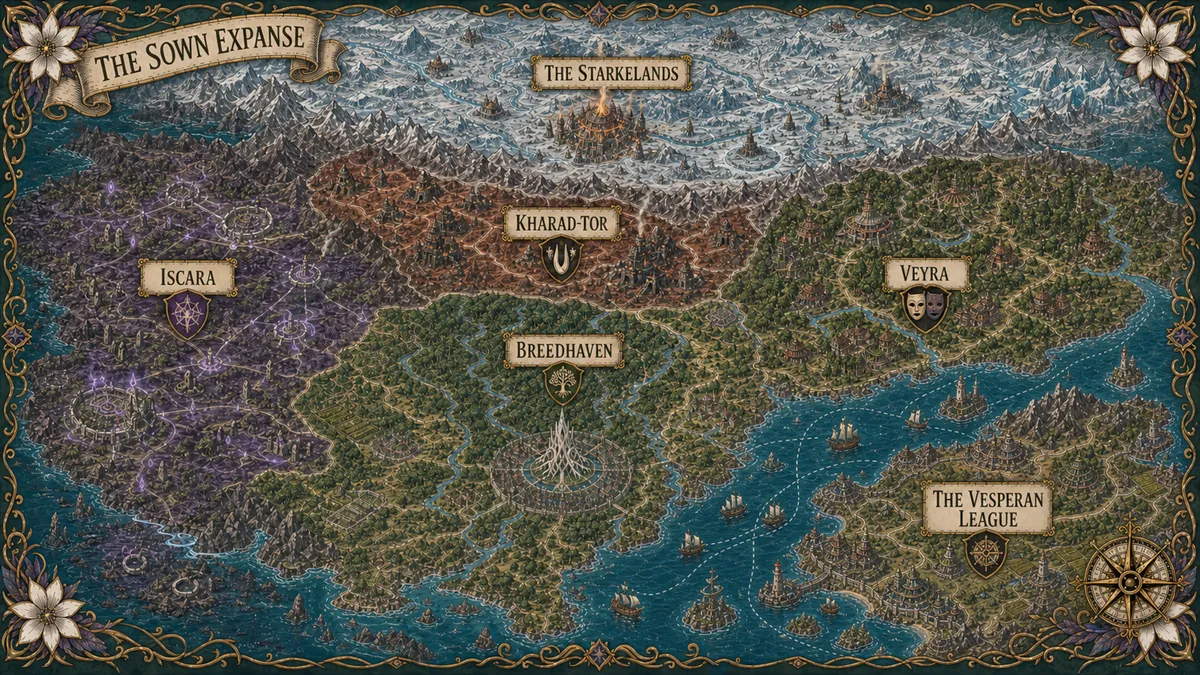
Illustrated map of the Sown Expanse showing Breedhaven, Iscara, Kharad-Tor, Veyra, the Starkelands, and the Vesperan League

The Sown Expanse is the known world. The Bloom reaches all of it, and in every nation women outnumber men seven to one. Breedhaven is one prosperous state among several, linked to the rest by rail, sea, the net and a few long-range portal lines.

Kharad-Tor is the orc federation of the red hills to the north: mines, steelworks and the most disciplined army in the Expanse, governed by a Council of War-Mothers. Veyra, to the east, is the beastkin democracy, where no one people holds a majority and the diplomats are very good — as is its intelligence service, the Quiet Office.

Iscara is governed by its mages, under a Sorceress Queen who wins her title in open demonstration; it built and runs the portal network. The Vesperan League is a maritime power founded by pirate queens who agreed to split the sea lanes instead of raiding one another, and treats everything as a deal. The Starkelands are the frozen north, where almost everyone lives in one vast heated city, Hearthspire.

Every one of them takes an interest in strong Sires. Some are franker about it than others.

— ix —